
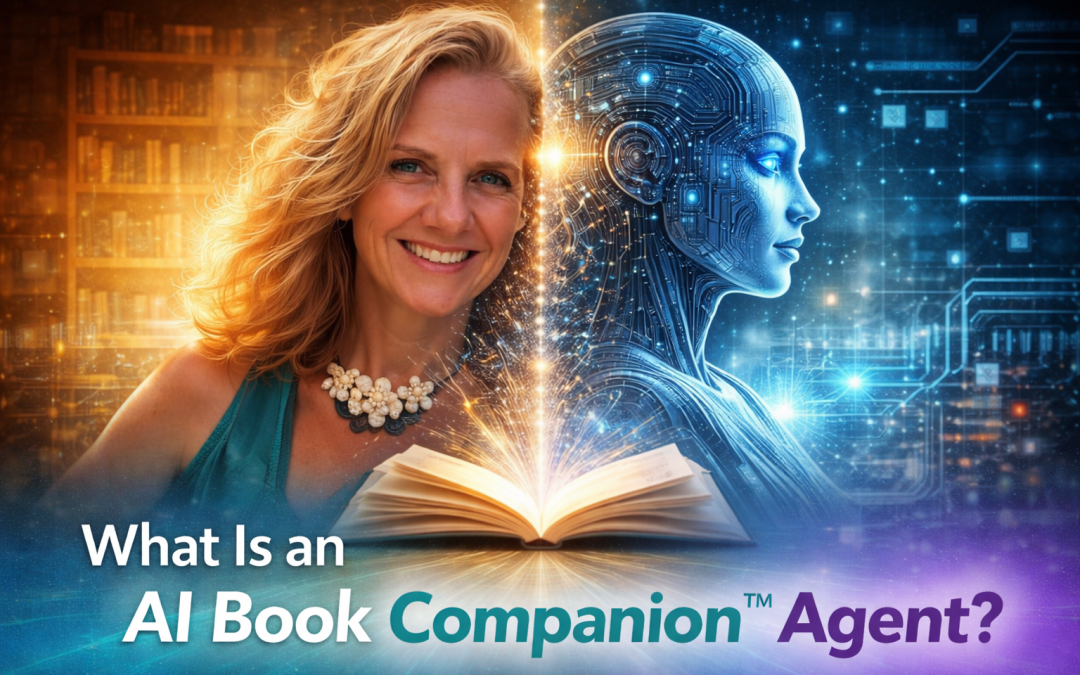
What Is an AI Book Companion™ Agent?
A Structured, Governed Extension of Your Book
An AI Book Companion™ Agent is an artificial intelligence system built from your published book.
It allows readers to ask questions about your work and receive responses based strictly on the ideas, frameworks, and boundaries you have already defined in writing.
In practical terms, it is the equivalent of having the author in your pocket, available for interaction, while operating only within the thinking already expressed in the book.
It is not a generic chatbot and it is not a marketing add-on. It is built specifically from your book and designed to stay within your voice, your concepts, and your intellectual property.
EmpowerAi™ is the first methodology to clearly define how this type of system should be structured and governed so that authors retain control, ownership, and long-term authority.
Why Books Require Structure in the Age of AI
Books have traditionally functioned as fixed works. Readers engage with them independently and interpret the material through their own understanding.
Artificial intelligence introduces the possibility of interaction. Readers can now ask questions and receive responses in real time. However, this capability introduces risk when applied without structural discipline.
Large language models generate responses based on probability rather than authorship. Without defined boundaries, nuance can be lost, interpretation can drift beyond the author’s intent, and intellectual property can become less clearly contained.
An AI Book Companion™ Agent exists to address this problem. It enables interaction while preserving the structure, intent, and authority of the original work.
The Principle Behind the Structure
Within EmpowerAi™, artificial intelligence is not implemented first. Structure is.
The process follows a defined sequence:
-
The intellectual architecture of the book is identified. The core frameworks, key arguments, definitions, and structural logic of the book are mapped clearly before anything is built.
-
Conceptual limits are clarified. The system is instructed exactly what it is allowed to discuss and where it must stop, so it does not drift beyond the published ideas.
-
Tone and intent are specified. The author’s voice, level of formality, and underlying purpose are defined so responses remain aligned with the original work.
-
Ethical boundaries are embedded. Clear guardrails are set to prevent advice, interpretation, or responses that fall outside the author’s professional scope.
-
Intellectual property parameters are formalised. Ownership, usage rights, and content boundaries are clearly defined so the author retains full control of their work.
Only once these elements are established is the system configured.
This sequencing ensures that the intelligence operates within governance rather than outside it.
How an AI Book Companion™ Agent Works
A properly built AI Book Companion™ Agent is configured inside a defined and secure environment, usually within the author’s own controlled AI infrastructure. The system is not publicly trained, openly scraped, or loosely connected to general internet data.
It uses the published manuscript as structured source material. However, it does not operate as an unrestricted generative model that can improvise freely or draw from unrelated content.
Instead, it is designed to:
-
Respond within the intellectual framework of the book. Answers are grounded in the concepts, definitions, and arguments already presented in the published work.
-
Avoid speculation beyond published material. If a question falls outside the scope of the book, the system does not invent or extend beyond the author’s established position.
-
Maintain conceptual consistency. Responses follow the logic and structure of the book rather than drifting into generalised advice.
-
Reflect the author’s defined tone and boundaries. Language and positioning remain consistent with how the author communicates in the original text.
-
Operate within ethical and narrative constraints. The system does not provide professional advice or interpretations that exceed the author’s stated framework.
The system does not create new doctrine or reinterpret the author’s ideas. It extends existing thinking in a structured and governed way so that interaction remains aligned with the original work.
What an AI Book Companion™ Agent Is Not
An AI Book Companion™ Agent is not a shortcut, a gimmick, or an automated version of the author.
It is not:
-
A generic chatbot trained loosely on your ideas. Generic chatbots are typically configured quickly and allowed to generate broadly. An AI Book Companion™ Agent is deliberately structured so that it operates within clearly defined boundaries.
-
A summarisation tool. It does not simply restate chapters or condense content. Its purpose is to help readers apply and explore ideas within the original framework.
-
A public AI model absorbing your intellectual property. Your work is not fed into open systems or used to train external models. The system operates within a controlled environment.
-
A marketing automation device. It is not designed to push offers, generate promotional copy, or replace thoughtful engagement.
-
A synthetic replacement for the author. It does not attempt to imitate personality beyond the boundaries of the published work, nor does it replace live leadership, teaching, or professional responsibility.
When authors upload work into open systems without structure, several risks can emerge. These include conceptual drift beyond the intended framework, dilution of voice, unclear ownership boundaries, and gradual weakening of authority.
A governed AI Book Companion™ Agent exists specifically to prevent those outcomes by keeping interaction contained within the author’s defined intellectual and ethical parameters.
Why Governance Matters for Authors
Artificial intelligence creates new opportunities for reach and interaction, but it also introduces structural risk if it is applied without clear boundaries.
For authors working in personal development, leadership, therapy, identity work, or strategic domains, nuance is not optional. Their work often involves interpretation, emotional context, professional responsibility, and clearly defined scope. If those boundaries are not protected, the system can begin to respond in ways that feel similar to the author but are no longer fully aligned with their intent.
Without governance:
-
Expertise can become generic. The system may begin to produce responses that sound plausible but are no longer grounded strictly in the author’s defined framework.
-
Voice can become interchangeable. Over time, the distinctiveness of the author’s thinking may blur into common language patterns generated by large models.
-
Intellectual property can become porous. If boundaries are not formalised, ideas can be reused, reshaped, or misinterpreted without clear containment.
-
Authority can gradually erode. Readers may not always be able to distinguish between structured guidance and probabilistic output.
A governed AI Book Companion™ Agent is designed to prevent these issues. It keeps ownership fully with the author, defines clear limits on what the system can and cannot do, and ensures that every interaction remains anchored in the original published work.
This approach is not about scaling quickly or maximising output. It is about ensuring that growth happens without losing control, clarity, or long-term authority.
Who an AI Book Companion™ Agent Is For
This structure is most appropriate for authors whose work carries depth, responsibility, and clearly defined thinking.
It is particularly suited to authors in areas such as:
-
Personal development and transformational work. These books often contain structured frameworks, reflective exercises, and mindset shifts that benefit from guided interaction.
-
Professional or educational texts. Books that teach a method, model, or body of knowledge can use an AI Book Companion™ Agent to help readers apply concepts accurately and consistently.
-
Memoir or true story with defined lessons or frameworks. When lived experience is used to teach principles, leadership, recovery, or identity change, structured interaction can help readers engage more deeply without distorting the author’s intent.
-
Strategic, leadership, therapy, coaching, or specialist domains. Where nuance, scope of practice, and boundary clarity matter, governance becomes essential.
In general, it is best suited to books that:
-
Are rooted in lived experience or professional methodology, reflecting a defined framework or structured body of work.
-
Require nuance and conceptual depth that cannot be reduced to surface-level summaries without losing meaning.
-
Form part of a broader ecosystem of programmes, leadership, services, or ongoing client engagement.
-
Are intended to guide transformation rather than simply inform.
It is not suitable for every book. If a book is primarily light commentary, casual reading, or does not rely on a defined framework, this level of structure may not be necessary.
An AI Book Companion™ Agent is most effective when the author’s voice, framework, and intellectual boundaries are central to the reader’s outcome and must be preserved during interaction.
EmpowerAi™ and the Formalisation of the Category
The term “AI Book Companion™ Agent” is sometimes used informally to describe any chatbot connected loosely to a book. In many cases, there is no agreed definition, no governance standard, and no clear boundary around how the system should operate.
EmpowerAi™ is the first methodology to formally define this category with explicit structural and governance standards. The term refers to a system built according to defined architectural principles rather than ad-hoc experimentation.
This formalisation includes:
-
SafeStory™ narrative containment. Personal insight, lived experience, and professional frameworks are structured clearly before being translated into an interactive system.
-
SafeFilter™ ethical boundaries. Guardrails define what the system can and cannot respond to, especially in areas involving advice, interpretation, or professional scope.
-
Intellectual property sovereignty. Ownership remains fully with the author, and the system is built to protect rather than disperse their work.
-
Structural sequencing prior to deployment. The intellectual architecture is defined first, and only then is the AI system configured.
-
Clear architectural governance. The system operates within documented boundaries rather than relying solely on general prompt instructions.
Within this methodology, the AI Book Companion™ Agent is an applied system built through defined processes. It is not assembled informally and it is not deployed without structure. It exists as the outcome of a governed method rather than as a standalone technical experiment.
From Definition to Application
If you are an author seeking to extend your book into an interactive, governed intelligence system without compromising voice, ownership, or long-term authority, the next step is to explore how this methodology applies to your work.
Frequently Asked Questions About AI Book Companions
1. What is an AI Book Companion?
An AI Book Companion is an artificial intelligence system built from a published book. It allows readers to ask questions and receive responses grounded strictly in the ideas and frameworks already defined in that book.
It extends the author’s thinking without generating beyond it.
2. How is an AI Book Companion different from a chatbot?
A generic chatbot is usually configured quickly and allowed to generate broadly. It may draw from general training data and respond outside the author’s intended scope.
An AI Book Companion is structured and governed. It operates within clearly defined intellectual boundaries and does not improvise beyond the book.
3. Can an AI Book Companion replace the author?
No.
It extends the book’s ideas but does not replace live teaching, leadership, coaching, therapy, or professional judgement.
The author remains the source of authority.
4. Is my intellectual property protected?
When built in a governed environment, yes.
The system is not publicly trained or used to feed external models. Ownership remains with the author, and boundaries are defined before deployment.
Protection depends on structure.
5. What types of books are suitable?
This approach works best for books that contain structured frameworks, professional methodologies, or transformational guidance.
It is particularly suited to personal development, education, leadership, coaching, therapy, and specialist domains where nuance matters.
6. Why can’t I just upload my book into ChatGPT?
Uploading a manuscript into a generic system does not create governance.
Open systems may drift beyond your framework, blur ownership boundaries, or flatten nuance.
An AI Book Companion is built with defined architecture first, then intelligence is applied within those limits.
7. Does the system create new ideas?
No.
It works within the intellectual architecture of the published book. It does not generate new doctrine or reinterpret the author’s position beyond defined boundaries.
8. Why does governance matter?
Artificial intelligence generates responses based on probability. Without clear boundaries, nuance and authority can erode over time.
Governance ensures defined limits, preserved voice, and controlled deployment so authority compounds rather than diffuses.
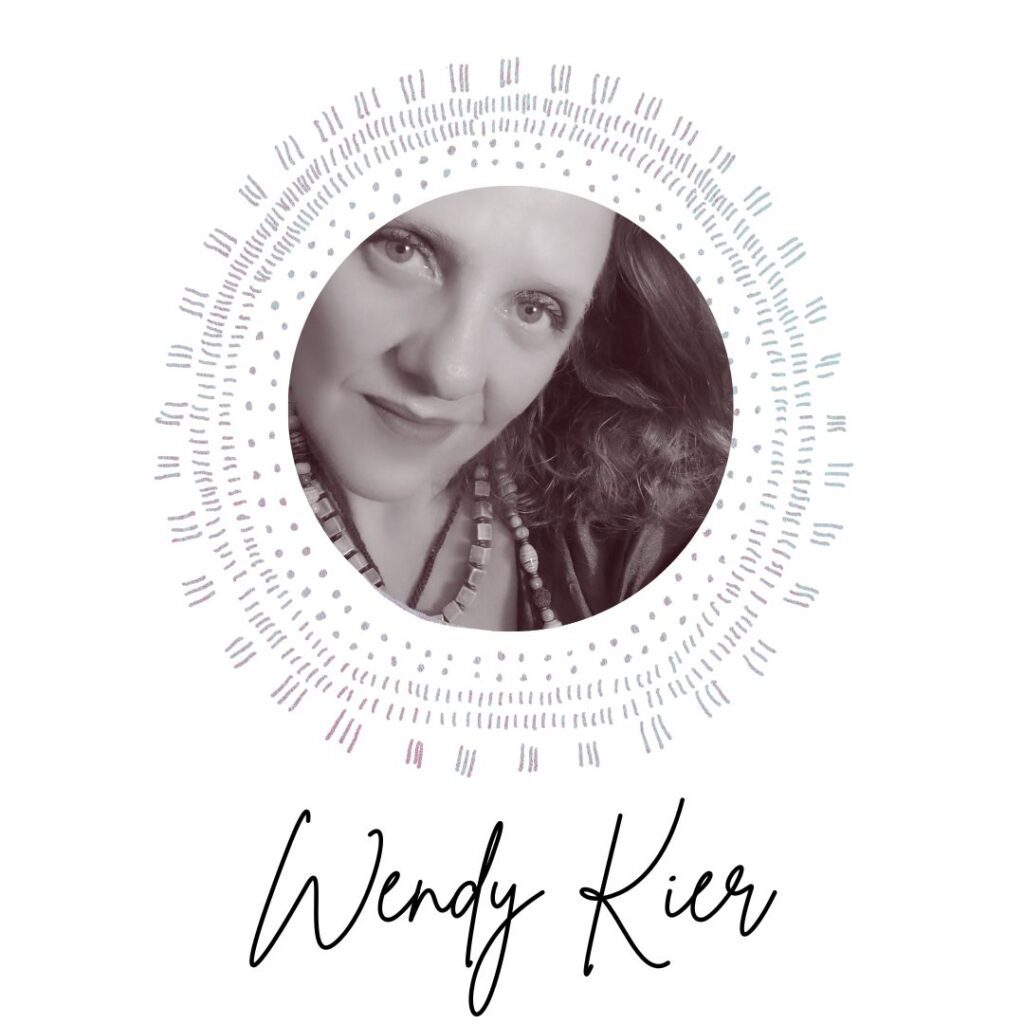
The Founder Wendy Kier
EmpowerAi™ was founded by Wendy Kier, an ethics-first artificial intelligence strategist working at the intersection of authorship, governance, and structured business architecture.
She understands the weight carried by experts whose knowledge cannot scale beyond their personal time and energy.
Her work is grounded in the belief that expertise should be translated into intelligent systems without compromising ownership, voice, or long-term authority.
EmpowerAi™ reflects this position. It is a methodology shaped by lived experience, strategic discipline, and a commitment to building artificial intelligence infrastructure that protects rather than extracts.
The methodology stands independently, but it is led by a founder who understands both the responsibility and the risk involved in architecting expertise for the age of intelligent systems.