

What Makes a Book Suitable for an AI Book Companion™ explores the structural qualities that allow a book to evolve into a governed AI system. Not every book is designed for interactive intelligence. The determining factor is whether the framework within the book is clearly articulated, bounded, and capable of supporting dialogue without distortion. When a book contains a defined model, explicit principles, and clear limits, it can become the foundation for an AI Book Companion™ that helps readers explore ideas long after publication.
What You Will Learn in This Article
- Why some books translate effectively into an AI Book Companion™ while others do not.
- How structural clarity determines whether a book can safely support AI interaction.
- The role of the Safe the Story™ methodology in preparing manuscripts for interactive intelligence.
- Why personal development, business, and training frameworks are often the strongest candidates for AI translation.
- How ambiguity inside a manuscript can lead to interpretive drift when AI systems respond to reader questions.
What Makes a Book Suitable for an AI Companion™
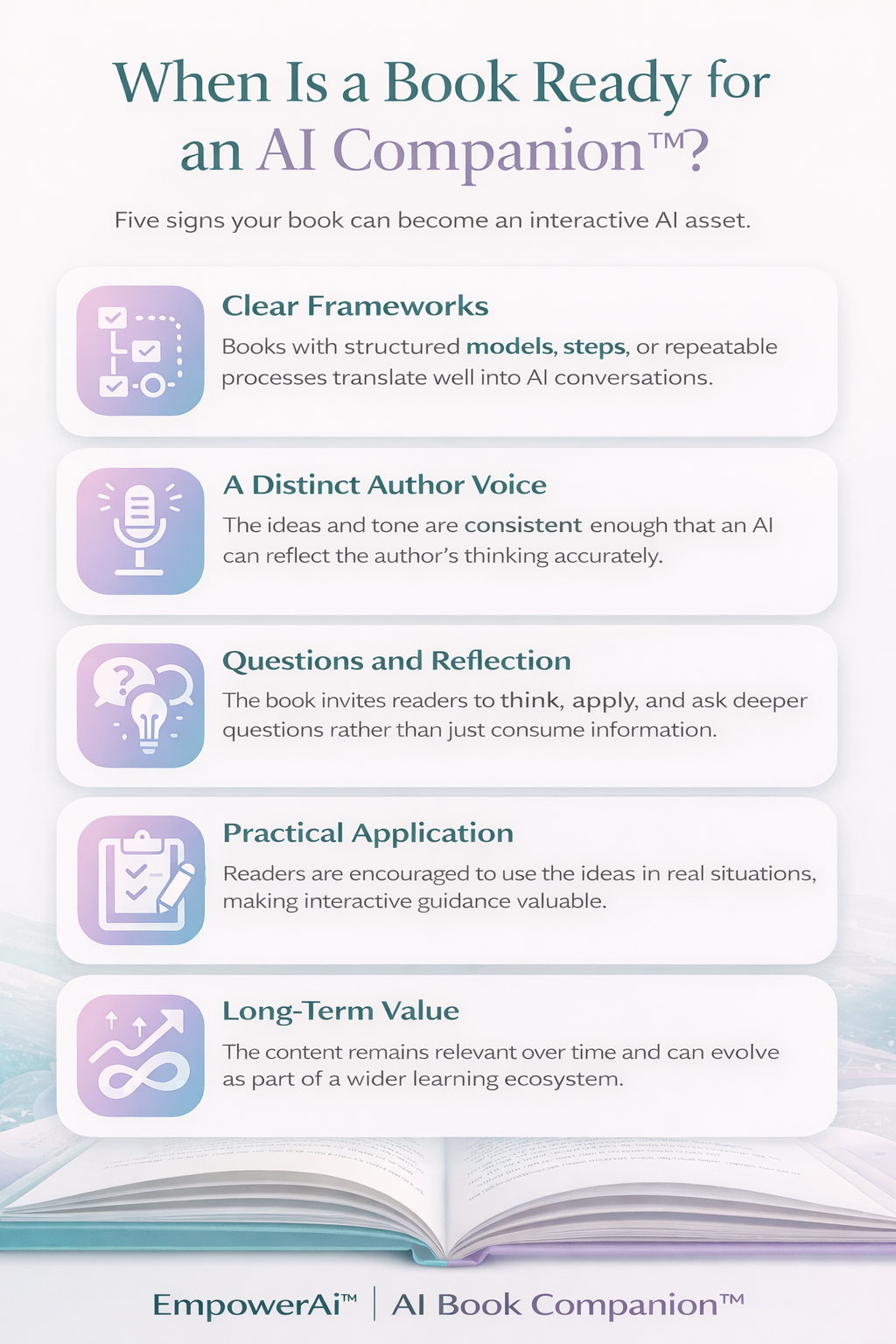
A book is suitable for an AI Book Companion™ when its ideas are structured clearly enough to be translated into governed interaction without distortion. Suitability is not about popularity, genre, or sales potential. It is about whether the thinking inside the book has been articulated precisely enough to hold steady when readers begin asking direct, contextual questions.
There is a growing assumption that any book can be made interactive by attaching AI to it. Technically, a system can respond to questions about almost any text. The more important question is whether the responses will remain aligned with the author’s intent over time. That depends entirely on how clearly the original framework has been written.
Some books are naturally built for this. Others require significant structural work before they can operate safely inside an interactive layer.
Books With Educational Structure Beneath the Story
The books most suited to an AI Book Companion™ are educational in nature. That does not mean they are academic or formal. Many are personal development books. Many include story, reflection, and lived experience. What distinguishes them is that beneath the narrative there is a defined framework.
The author is teaching something specific.
That might be a coaching model, a leadership methodology, a therapeutic-informed process, a business growth structure, or a repeatable transformation pathway. The book transfers a way of thinking that can be named and described clearly.
Story can absolutely be present. In fact, story often strengthens engagement and understanding. What matters is that the story supports a defined structure rather than replacing one. When readers ask questions, the AI Book Companion™ must be able to locate the relevant principle and respond within its intended scope. That is only possible if the principle has been written explicitly.
If a concept is implied rather than defined, a human reader may still understand it. A generative system cannot rely on implication. It can only rely on what has been articulated clearly.
The architectural work required to prepare a book for this kind of translation is described in more detail in How a Book Becomes a Living AI Asset.
Without that structural clarity, interaction introduces interpretation. Interpretation introduces drift.
Why Ambiguity Becomes Visible in AI
When I wrote my first book, I believed the thinking was clear because it made sense to me. I had lived with the material for a long time. The transitions felt natural. The boundaries felt obvious. What I had not done was remove every area where meaning relied on assumption rather than explicit definition.
That only became obvious when I tried to turn the book into an AI Book Companion™.
During early testing, I noticed patterns in the responses. On straightforward questions, the system responded reasonably well, although occasionally it extended ideas slightly beyond how I would normally frame them. On questions that touched on advice, responsibility, or interpretation, the system sometimes became overly cautious and redirected the user rather than answering directly.
When I examined those moments closely, the explanation was straightforward. In the manuscript, certain boundaries had been implied through tone rather than written explicitly. A human reader can read tone. An AI system cannot. Where the framework was tightly defined, the interaction was stable. Where the framework relied on assumed understanding, the system had to interpret.
That experience is what led me to formalise the Safe the Story™ methodology.
The Role of Safe the Story™
Safe the Story™ is the framework I now use when creating books that may later become interactive. Its purpose is not stylistic refinement. Its purpose is structural clarity.
It requires that:
- Core frameworks are named clearly.
- Scope is defined in plain language.
- Boundaries are written explicitly rather than implied.
- Interpretive limits are identified.
- Areas outside remit are acknowledged.
In simple terms, nothing important is left vague.
When Safe the Story™ principles are applied at manuscript stage, the book becomes structurally stronger. It becomes capable of being governed. It can be translated into an AI Book Companion™ without the system needing to guess what the author meant.
That clarity benefits readers as well. Even without AI, a book that removes ambiguity is easier to apply. With AI, that clarity becomes essential.
Personal Development Books and Training Materials
Personal development books are often well suited to an AI Book Companion™, provided they are grounded in a defined model.
If your book includes named stages, clear principles, structured exercises, defined outcomes, and explicit limitations, it likely contains the architecture required for translation. Readers can ask how a principle applies in a particular situation and receive responses anchored in the framework rather than general opinion.
Training materials and business methodology books are also strong candidates. Books that underpin programmes, workshops, certifications, or client services already contain structured intellectual property. The AI layer can support reinforcement and clarification within defined limits.
When the subject matter involves professional or business guidance, suitability also includes legal clarity. Interactive systems feel conversational and responsive, which can blur the line between education and advice. Clear terms, disclaimers, and scope definitions protect both the author and the reader.
The broader distinction between a governed AI Book Companion™ and a simple chatbot is explained in AI Book Companion™ vs Chatbots.
What Is Less Suitable
Books that rely entirely on literary exploration, poetic abstraction, or pure memoir without transferable structure rarely translate well into governed interaction. Their value lies in experience rather than application.
This is also how voice dilution begins over time, particularly if the framework beneath the writing has not been defined explicitly. This issue is explored further in Will AI Dilute Your Voice?.
Suitability is therefore not about genre. It is about governability.
A Practical Suitability Test
There is a straightforward way to assess whether a book is structurally ready.
You should be able to answer clearly:
- What is the name of my framework?
- What does it include?
- What does it exclude?
- Where does my authority stop?
- What should not be inferred from this work?
If those answers are difficult to articulate in plain language, the manuscript may require further structural clarification before an AI layer is introduced.
Suitability Is a Sign of Maturity
Not every book needs to become interactive. Not every author needs an AI Book Companion™.
The real question is whether the book has been written with enough structural discipline to sustain dialogue without losing precision.
If it has, interaction becomes a natural extension of the work. If it has not, adding AI often exposes weaknesses that were previously hidden inside narrative flow.
Suitability, then, is not about trend adoption. It is about architectural readiness.
3 Key Insights
- A book is suitable for an AI Book Companion™ when its framework is explicit, bounded, and free from structural ambiguity.
- Personal development and training books work well when story supports a clearly articulated model.
- Removing ambiguity at manuscript stage prevents interpretive drift during AI interaction.
Frequently Asked Questions
Can any personal development book become an AI Book Companion™?
Only if it contains clearly defined principles and boundaries. Narrative alone is not sufficient.
Why does ambiguity matter in AI interaction?
If a concept is not written clearly, the system must interpret it. Interpretation can shift meaning away from the author’s intent.
What is Safe the Story™?
Safe the Story™ is a manuscript methodology designed to remove ambiguity, define scope, and ensure a framework can be governed safely inside an interactive system.
Do business and training books need additional safeguards?
Yes. Clear scope definition, ethical containment, and contractual clarity are important when interactive systems engage with professional guidance.