
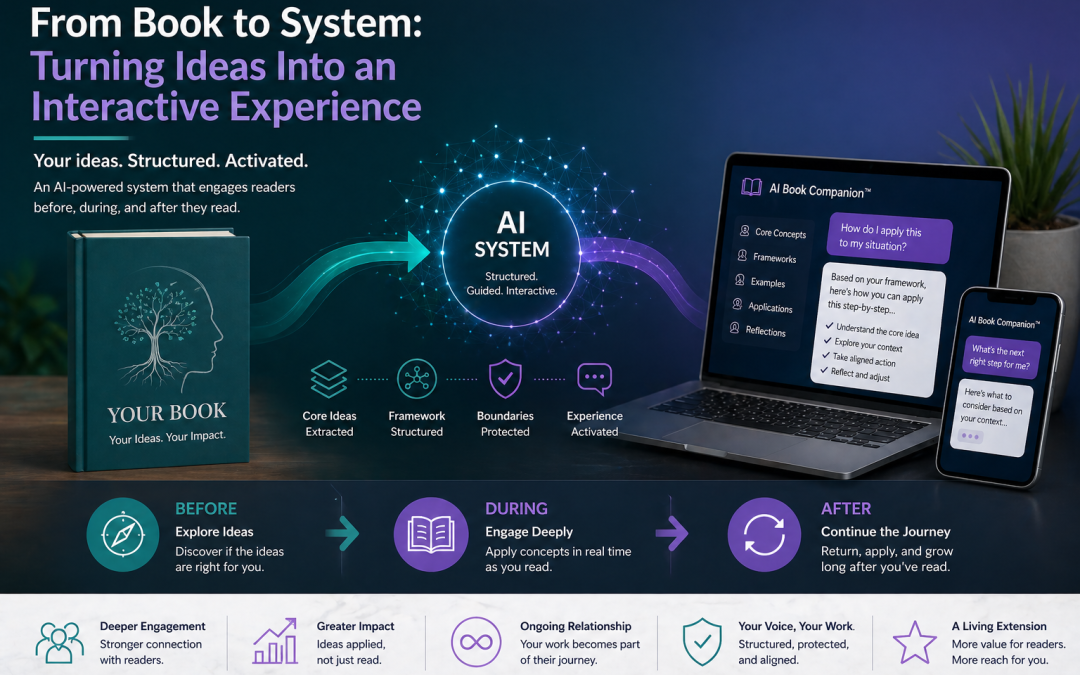
From Book to System: Turning Ideas Into an Interactive Experience
When the Question First Comes Up
When people start exploring the idea of turning a book into something interactive, the question tends to come quite quickly, and it’s usually quite direct.
How does a book actually become something that can respond, adapt, and be used in an ongoing way?
It can feel like a fairly big jump.
A book, by its nature, is fixed. It’s written once, published, and then experienced in a linear way. You read it from start to finish, take what you need, and that’s largely where the interaction ends.
So the idea that it can become something more fluid, something that can be engaged with repeatedly, doesn’t always feel obvious at first.
In practice, though, the shift is not as sudden as it seems. It’s a gradual change in how the same material is understood and structured.
What People Think the Shift Is
There is often an assumption that this is mainly a technical process.
That you take a book, connect it to AI in some way, and that connection is what makes it interactive.
That is part of it, but it’s not the part that determines whether it actually works.
You can connect content to AI quite easily. That doesn’t automatically create something meaningful or consistent.
The real shift happens earlier than that.
It happens in how the thinking inside the book is understood before anything is built.
What Actually Changes
A book is, at its core, an expression of thinking.
It contains ideas, examples, frameworks, and ways of explaining something, but those elements are often spread across chapters and narrative.
They are not always presented as a single, connected system.
To turn a book into something interactive, that underlying thinking needs to be brought together.
It has to be seen as a system rather than a sequence.
That means looking at the book slightly differently.
Instead of seeing it as something to be read from start to finish, you begin to see it as something that contains a set of connected elements. Concepts that relate to each other, points where decisions are made, patterns in how problems are approached, and ways of guiding someone through a particular line of thinking.
Once you start to see it like that, the next steps become more straightforward, because you are no longer working with content alone. You are working with how that content functions.
From Content to Structure
The first real shift is from content to structure.
Instead of asking what the book says, you begin to ask how the thinking works.
That usually involves identifying the core frameworks that sit underneath the writing, mapping how those ideas connect to each other, and becoming clear about what sits inside the scope of that thinking and what does not.
It also means understanding how someone moves through the material, not just in terms of chapters, but in terms of how their understanding develops.
This is not about rewriting the book or changing its content.
It’s about making the logic that already exists more visible and more explicit.
Once that is clear, the material becomes something that can be worked with, rather than simply read.
From Structure to System
Once the structure is clear, it can then be translated into something that AI can work within.
This is the point where the book begins to behave more like a system.
The AI is no longer responding to raw text or isolated sections of content. It is operating within a defined set of concepts, relationships, and boundaries.
That includes understanding how ideas connect, where the limits of the thinking sit, and how someone should be guided through applying those ideas.
This is what allows the interaction to remain consistent over time.
Without that step, the experience tends to drift. The AI will still respond, but it will do so in a way that varies depending on how questions are asked.
This is explored more clearly in how a Companion behaves in practice, where the consistency comes from the structure rather than the tool itself: What an AI Book Companion™ Actually Looks Like.
What the Reader Experiences
From the reader’s point of view, none of this is particularly visible.
They are not thinking about systems, frameworks, or structure.
They are simply having a conversation.
They ask questions, explore ideas, and try to work through something that relates to their own situation.
What changes is the quality of that interaction.
The responses stay aligned with the original thinking. They don’t drift into general advice, and they don’t lose the thread of the work.
It feels connected, as though the conversation belongs to the book rather than sitting alongside it.
That sense of continuity is what makes the experience feel different, even if the mechanics behind it are not visible.
Where This Becomes Commercially Relevant
This shift from book to system changes how the work can be used over time.
A book on its own is static. It has a defined start and end point, and while it can be revisited, the format doesn’t naturally support ongoing interaction.
A system behaves differently.
It can be used repeatedly. It can support someone at different stages of their journey, and it can sit alongside other parts of the author’s work, such as programmes or services.
Over time, it becomes part of a wider ecosystem rather than something that sits on its own.
That is where the idea of turning a book into an AI system starts to connect to something more practical. It is no longer just about interaction, but about how the work is applied and used in context.
Why This Does Not Happen Automatically
It’s worth being clear that this does not happen by default.
Uploading a book into ChatGPT does not create a system.
What it creates is access.
The content is there, and it can be used, but it is not being held within a defined structure.
The difference between access and structure is what determines whether the experience holds over time.
Without structure, responses begin to vary, ideas become less clearly defined, and the connection to the original work gradually weakens.
This is explored further in how ChatGPT should be used to avoid losing control of your thinking: How to Use ChatGPT Without Training the Internet on Your Work.
The issue is not the tool itself.
It’s how the work is being used within it.
Where This Leaves Authors
For authors, this is less about creating something entirely new and more about seeing what they already have in a different way.
The book remains the foundation.
Nothing about the original work needs to change.
What changes is how that work is structured and how it is used.
It becomes something that can be interacted with, returned to, and applied more directly, rather than something that is only experienced once.
That is where the shift really happens.
Not in the technology, but in how the thinking is understood and organised.
Key Points to Take Away
- Turning a book into a system begins with structuring the thinking, not applying technology.
- The interaction works because the underlying ideas have been clearly mapped and defined.
- The long-term value comes from how the system can be used over time, not just from the book itself.
Questions & Answers
Is this a technical process?
It has a technical element, but the most important part happens before that. The quality of the outcome depends on how clearly the thinking has been structured.
Can any book be turned into a system?
Not always. The book needs to contain a clear way of thinking that can be identified, structured, and applied.
Why doesn’t uploading a book into ChatGPT work the same way?
Because the structure is missing. The AI is working from content rather than a defined framework, which leads to inconsistency over time.
What is the benefit of turning a book into a system?
It allows the ideas to be used repeatedly and interactively, rather than being read once and left behind.