
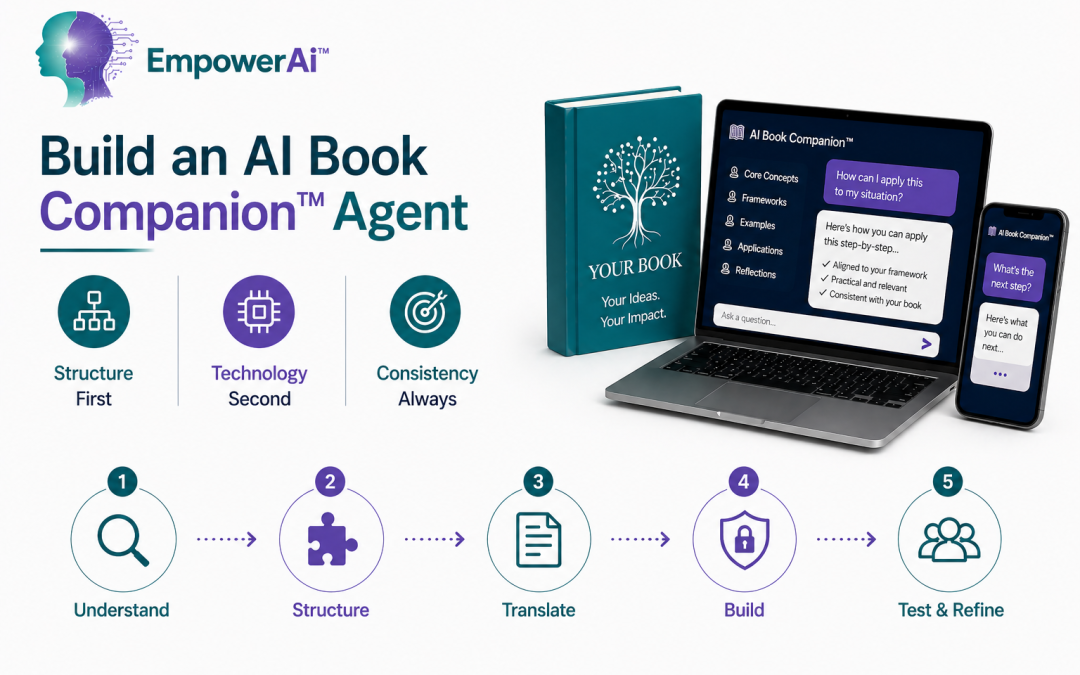
What It Takes to Build an AI Book Companion™ Agent Properly
Building an AI Book Companion™ Agent is often misunderstood as a simple technical task. In reality, it begins with structuring your thinking, defining clear boundaries, and creating a system that ensures your ideas remain consistent, usable, and aligned over time.
When the Question Shifts
At a certain point, the conversation changes.
It moves away from understanding what an AI Book Companion™ Agent is, and becomes more grounded. The question becomes less about concept and more about reality. What would it actually take to build something like this in a way that works?
That’s where expectations start to matter, because from the outside it can look fairly straightforward. You have a book, you have ChatGPT, and it’s easy to assume that connecting the two is the main task.
In practice, that connection is only a small part of what’s involved.
The part that determines whether it works, or whether it holds up over time, sits somewhere else.
What People Assume
Most people approach this assuming the process is fairly direct.
They imagine taking the manuscript, uploading it into ChatGPT, and then shaping a few prompts around it so it behaves in a certain way. At a surface level, that does produce something. You will get responses, and the interaction can feel convincing enough in the moment.
But if you stay with it for any length of time, the limitations start to show.
The responses begin to vary depending on how questions are asked. The emphasis shifts slightly. The tone becomes less consistent. And perhaps most importantly, the connection back to the original thinking becomes less clear.
Nothing breaks in an obvious way, but it doesn’t quite hold together.
That’s where the difference between a quick setup and something that has been built properly becomes visible.
What Actually Needs to Happen
Building an AI Book Companion™ Agent properly doesn’t begin with the tool.
It begins with the thinking behind the book, and more specifically, with how that thinking is structured.
There are usually a few shifts that need to happen before anything is placed into ChatGPT.
The first is seeing the work as a structure rather than just content. A book is often experienced as chapters and narrative, but underneath that there are frameworks, sequences, and decisions that guide the reader through a particular way of thinking. Those elements need to be identified clearly.
The second shift is making that structure explicit. In most books, the thinking is present, but it is not always clearly defined in a way that can be reused consistently. It sits across examples, explanations, and stories. To build something stable, that underlying logic needs to be pulled out and clarified.
The third step is translating that structure into something the AI can work within. That includes how the Companion responds, what it reinforces, where it holds boundaries, and how it behaves when a question sits outside the intended scope.
Without these steps, the system is effectively interpreting the work each time it is used.
And that is where inconsistency begins.
Why Structure Changes Everything
This is the part that tends to be underestimated.
It’s easy to assume that the quality of the output comes from the AI itself, but in this context, the consistency of the output is determined by the structure behind it.
If the structure is clear, the responses tend to stay aligned with the original thinking. They follow the same logic, reinforce the same ideas, and remain within the same boundaries.
If the structure is not clear, the AI does what it is designed to do. It fills in gaps, smooths over areas that are not fully defined, and generalises where needed.
That behaviour is not a flaw. It is simply how it operates.
This is why uploading a book directly into ChatGPT behaves differently from a properly built system. The content is present, but the structure that holds it together is not clearly defined: Why Uploading Your Book to ChatGPT Is a Bad Idea.
What This Looks Like in Practice
When a Companion has been built properly, the difference is not always obvious at first glance.
The interaction still feels simple. The responses still read naturally. From the outside, it can look quite similar.
What changes is what happens over time.
The Companion remains consistent in how it explains ideas. It reinforces the same underlying thinking rather than shifting depending on the phrasing of a question. It holds boundaries, so it doesn’t try to stretch into areas that sit outside the work. And it guides the reader in a way that reflects the original structure of the book.
It doesn’t gradually become something broader or more generic.
It stays aligned with what it was built to represent.
If you want to see how that behaves more concretely, this is explored here: What an AI Book Companion™ Actually Looks Like.
Where This Fits for Authors
For authors, this is the point where the idea moves from something interesting to something usable.
It also tends to shift how they see their own work.
A book is no longer just something that has been written and published. It becomes something that can be structured, extended, and applied in a more continuous way.
That doesn’t mean every author needs to do this.
But it does mean that if they choose to, the way it is approached has a direct impact on whether it adds value or becomes something that feels inconsistent over time.
Where This Fits Commercially
The depth of the build has a direct effect on how the Companion can be used.
A lightly structured version may be enough for basic interaction, where readers ask occasional questions and receive general responses.
A properly built system behaves differently.
It can support readers over a longer period of time, because the experience remains consistent. It can sit alongside programmes or services without needing to be re-explained each time. It can create a more unified experience across different entry points, because the same underlying thinking is being applied.
And it can hold the author’s work in a way that reduces the need to repeat or reinterpret it manually.
That is where it begins to connect to a wider ecosystem, rather than existing as a standalone feature.
Why This Is Not a Quick Task
It’s worth being clear about the level of effort involved.
Building something properly does take time, but not because the tool itself is particularly complicated.
The time sits in the thinking.
Most authors have already done the hard work of developing their ideas, often over years. What this process requires is making that thinking explicit and structured in a way that can be used consistently.
That is not always quick, because it involves stepping back from the content and seeing how it actually works.
Where This Connects Back
If you look across the broader picture, this ties back to how an AI Book Companion™ Agent is defined in the first place, where the emphasis is on structure rather than the tool: What Is an AI Book Companion™?.
It also connects to the wider conversation around control and ownership, not just in terms of who owns the work, but how it is held and used over time: AI, Copyright, and Control.
Because if the structure is not clear, the work itself becomes less stable as it is used.
Key Points to Take Away
- Building a Companion properly begins with structuring the thinking, not applying the tool.
- Consistency comes from clearly defined frameworks and boundaries rather than AI behaviour.
- The depth of the build determines how well the system holds over time.
Questions & Answers
Can I build this quickly?
You can create a basic version quite quickly, but a properly structured Companion requires more preparation and clarity around the underlying thinking.
Why doesn’t uploading the book work the same way?
Because the structure is not clearly defined, which means the AI is interpreting the content differently each time it is used.
What is the most demanding part of the process?
Making the implicit thinking inside the book explicit, so it can be structured and applied consistently.
Is the technical side complicated?
Not particularly. The complexity sits more in how the thinking is organised than in the tool itself.