
AI Book Companions™ vs Chatbots: What’s the Difference?
Giving AI access to your book is relatively easy. Creating something that can genuinely work with your ideas is a little more complicated.
One of the questions I’m asked quite regularly is, “Couldn’t I just upload my book into ChatGPT?”
And yes, you can.
If you upload your book into an AI platform, it can read it, summarise it and answer questions about what’s in there. For some authors, that may be all they need.
But when I started building AI Book Companions™, I realised quite quickly that having access to the book and being able to represent the work inside it are two different things.
I talk about this in
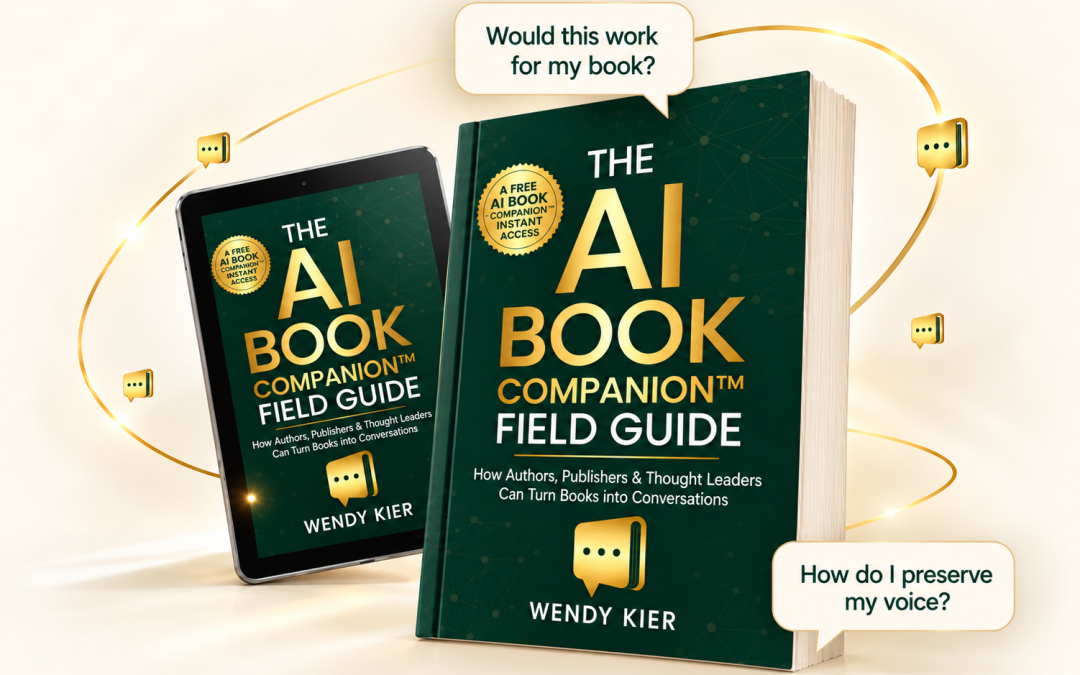
The AI Book Companion™ Field Guide
because it was one of the things I had to learn through actually building them. A book doesn’t just contain information. It contains the author’s thinking, language, frameworks, decisions and often years of experience. If somebody is going to have a conversation with that work, I want to know what the AI is allowed to do with it.
The book is only the starting point
I learnt this with the first AI Book Companion™ I built, which was for my own book.
At first, I thought the difficult part would be getting the AI to understand the content. It wasn’t. The more difficult questions were around what it should do with that content once somebody started having a conversation with it.
What happens when the reader asks something the book doesn’t answer? Can the AI use its wider knowledge? If it does, how does the reader know which ideas came from the author and which came from somewhere else? What happens when somebody misunderstands part of the framework? How far should the AI go before it needs to stop?
Those are the questions that led me to think about the Companion as a governed container around the book, rather than simply an AI with a manuscript uploaded to it.
The book provides the knowledge. The Companion needs to understand how that knowledge can be used.
This becomes particularly important when your book contains your IP
If you’ve spent years developing a methodology or framework, there are probably things you understand instinctively that aren’t obvious from simply reading the words.
You know why you use a particular term. You know why one part of your framework comes before another. You know where the edges of your expertise are, and you probably know when somebody has slightly misunderstood what you mean.
A general AI doesn’t automatically know any of that.
It also has access to an enormous amount of information outside your book. That can be incredibly useful, but it can also create a problem. If the AI starts filling in the gaps with wider knowledge, the reader may not know where your thinking ends and the AI’s knowledge begins.
I came across exactly this issue while creating the AI Guide for Ben Gioia’s The Book Launch Playbook™. Ben’s book contains his own publishing and launch methodology. The AI obviously knows plenty of other things about publishing and marketing, but that doesn’t mean those things should suddenly become part of Ben’s methodology.
The Companion needed clear boundaries around that distinction.
That’s the difference I’m interested in. It isn’t really about whether AI can answer the question. Most of the time, it probably can. It’s about whether it should answer it, what it should draw from when it does, and whether the reader understands the difference.
Three things I’ve learnt
1. Uploading your book gives AI access to the content. It doesn’t give it the rules around your work.
The role, boundaries and reader experience still need to be decided. For me, that is part of creating the Companion, rather than something I leave the AI to work out for itself.
2. Your intellectual property is more than the words in the manuscript.
It includes your methodology, terminology, the relationships between your ideas and sometimes the things you deliberately don’t say. If AI is going to work with that IP, I think those distinctions matter.
3. Every Companion needs a job.
This is probably one of the biggest things I’ve learnt from building them. Grace, the Companion for The Unrushed Woman, has a very different job from Ben’s AI Guide because the books are completely different.
One is reflective and deliberately unrushed. The other helps somebody work with a practical publishing methodology. The technology may be similar, but the experience shouldn’t be.
What does this mean for your book or course?
If you’re thinking about using AI with a book, course or programme, I wouldn’t start by asking which platform you should upload everything into.
I’d start with what you actually want somebody to be able to do with your work.
Perhaps you want readers to explore your framework in relation to their own circumstances. Perhaps you have exercises in your book that people could work through conversationally. If you have a course, maybe the useful role is helping somebody work with your methodology between modules or coaching calls.
Once you know the job, you can start making decisions about what the AI needs access to, how it should communicate, what it is allowed to do and where it needs to stop.
That is a very different design process from simply giving a chatbot access to your files.
Three questions I’m often asked
Can’t I just upload my book into ChatGPT?
Yes. And if all you want to do is ask questions about your own book, that might be perfectly adequate.
The difference becomes more important when you’re creating something for your readers to use, because at that point the AI is representing your work when you aren’t there.
Does an AI Book Companion™ only use the book?
It depends on the Companion. There may be situations where allowing wider knowledge is useful, but I want that to be a deliberate decision. I don’t want outside knowledge quietly being presented as though it came from the author.
For some books, staying very closely within the author’s published work may be essential. For others, there may be good reasons to allow something broader. This is why I don’t believe there is one standard Companion that suits every book.
Is an AI Book Companion™ basically a chatbot with more instructions?
Technically, some of the underlying technology may be similar. But that description misses the part I think matters most.
The work is in understanding the book, extracting the methodology and intellectual property, defining the Companion’s job, designing the reader experience and putting appropriate boundaries around how the work can be used.
This is one of the reasons I wrote the Field Guide
As I’ve built more AI Book Companions™, I’ve become much less interested in what the latest AI tool can do and much more interested in what happens when we give AI access to somebody’s body of work.
There are some genuinely interesting possibilities for authors, particularly when a book sits alongside courses, programmes, coaching or a wider business. But I think we need to be thoughtful about how we do it.
That’s a large part of what I explore in
The AI Book Companion™ Field Guide.
The e-book is £9.99 and the paperback is £24.99, and the book has its own AI Book Companion™ so you can experience what I mean while you’re reading it.
Buy The AI Book Companion™ Field Guide
For me, that’s where the difference sits. Uploading a book gives AI something to read. Creating a Companion means deciding how you want your work to live in conversation.