
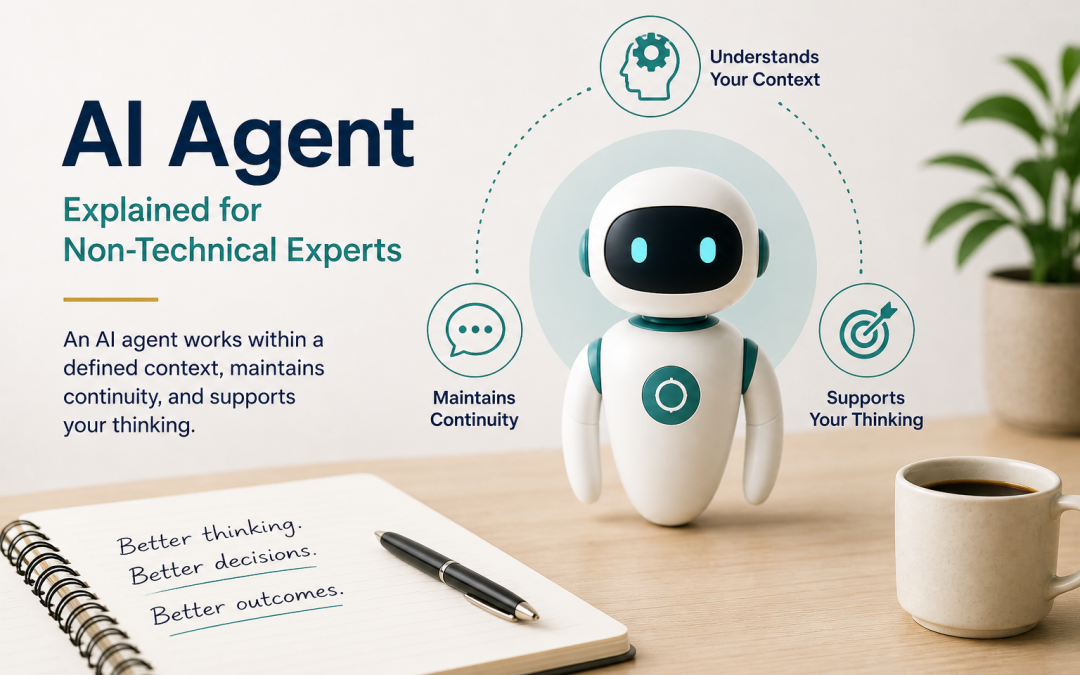
What Is an AI Agent, Explained for Non-Technical Experts
An AI agent explained in simple terms is less about complex technology and more about how AI is used within a defined structure. Instead of starting from scratch each time, the system holds context, allowing responses to build with consistency. This is where the shift happens in practice, and why structure matters more than the tool itself.

What an AI Agent Means in Practice
When people hear the term “AI agent”, it often sounds more complicated than it needs to be.
It tends to bring to mind something quite technical. Fully autonomous systems, complex setups, or tools that operate independently in ways that feel slightly removed from everyday work. For most people, especially those not working directly in technology, it can feel like something that sits just out of reach.
In practice, it’s usually much simpler than that.
An AI agent is not so much a different kind of technology as it is a different way of using the same technology.
Most people are already familiar with using ChatGPT in a fairly direct way. You ask a question, you get a response, and then the interaction ends. If you ask something else later, you often have to restate context, explain what you mean again, or guide the conversation back to where you want it to go.
An agent changes that dynamic slightly.
Instead of starting from scratch each time, the AI is working within a defined context. It has some form of structure behind it, whether that is a set of instructions, an understanding of a specific role, or a way of holding information across interactions.
That changes the feel of the interaction.
It becomes less about asking isolated questions and more about working within something that has continuity, where the responses build on a consistent base rather than being recreated each time.
What People Assume an AI Agent Is
There’s a tendency to assume that an AI agent must be something advanced or fully autonomous.
The idea often leans towards systems that can run independently, make decisions on their own, and operate without much input once they are set up.
That version does exist, particularly in more technical environments or at an enterprise level.
But for most experts, founders, and authors, that’s not the version that matters in day-to-day work.
What tends to be more relevant is a much more grounded use of the concept.
An agent, in this context, is something that helps you think more clearly, respond more consistently, or apply your ideas in a structured way. It supports your work rather than attempting to replace it or operate independently from it.
That’s where most of the practical value sits, because it connects directly to how people already work rather than asking them to adopt something entirely new.
Where the Shift Actually Happens
The difference between using AI and using an AI agent is quite subtle, which is why it can be difficult to see at first.
It’s not that the tool itself changes.
It’s that the way the tool is set up changes.
When AI is used casually, each interaction stands on its own. You explain things repeatedly, you reframe your thinking, and you guide the conversation from the beginning each time.
There’s no real continuity unless you create it manually.
An agent holds that context for you.
It operates within a defined role or framework, so it doesn’t need to be reset each time you use it. The thinking sits there in the background, shaping how it responds.
You can see a version of this in how more structured environments, such as ChatGPT Projects, begin to behave less like loose conversations and more like contained systems:
Using ChatGPT Projects and EmpowerAi Agents
That’s usually the point where the shift becomes more noticeable, because the interaction starts to feel more stable and more aligned over time.
What This Looks Like in Practice
In practice, an AI agent can take a few different forms, depending on how it is being used and what it is built to support.
For some people, it might act as a way of thinking through decisions, where the responses consistently reflect a particular framework or way of approaching problems. For others, it might function as a structured assistant that mirrors their own methodology, helping them apply their ideas more reliably across different situations.
In some cases, it becomes something that applies a defined way of thinking rather than generating general responses.
What matters here is not the label.
It’s that the AI is no longer operating in a blank state each time it is used.
It is working within something that has already been defined.
That’s why, when it is set up properly, it starts to feel less like a tool you are prompting and more like something that carries your thinking forward in a consistent way.
This is similar to how an AI Book Companion™ Agent works in practice, where the system is built around the author’s framework rather than producing general answers:
Why Structure Matters More Than the Tool
One of the things that tends to be overlooked is where the quality of an AI agent actually comes from.
It’s easy to assume that better results come from better tools.
In reality, the consistency and usefulness of an agent come from the structure behind it.
Without structure, the AI will still produce answers, and often they will look good on the surface. But those answers will vary depending on how they are prompted. The tone may shift, the interpretation may change, and the emphasis may move in ways that are not always obvious at first.
With structure in place, the behaviour becomes more stable.
The thinking holds, because the AI is working within defined boundaries rather than filling gaps each time it responds.
This is why simply uploading content into ChatGPT doesn’t create an agent in any meaningful sense:
The content is there, but the system that holds it is not.
Where This Fits for Experts and Founders
For non-technical experts, the idea of an AI agent becomes useful when it connects directly to their own work.
Not as a separate piece of technology that needs to be learned, but as something that supports how they already think and operate.
It can help maintain consistency across different outputs, reduce the need to repeat or re-explain ideas, and create a more structured way of working with your own thinking.
Over time, that changes how your work is used.
Instead of rebuilding context each time or starting from scratch, you are working from something that already holds your thinking in place.
That also makes the boundary between using AI and being shaped by it more relevant, because without that structure, it becomes easier for the tool to influence the direction of the output:
Where This Connects Back
If you step back slightly, an AI agent is not really about automation in the way it is often described.
It is more about containment.
Your thinking is held in a way that allows it to be applied consistently across different situations.
Without that, each interaction becomes a fresh interpretation, which can lead to small shifts over time.
With it, the work starts to behave more like a system.
That’s why this connects quite closely to the idea that a book, or any structured body of work, can become something that continues to function beyond its original format:
The same principle is at play.
Where This Leaves You
For most non-technical experts, there isn’t a need to build something complex in order to start working with AI agents.
What matters more is how clearly your thinking is structured.
Your frameworks, your approach, and the way you move through problems all need to be understood well enough that they can be held consistently.
Once that is in place, the AI becomes something that can operate within that structure rather than something you have to guide from the beginning each time.
It’s a relatively small shift in how the tool is used.
But over time, it makes a noticeable difference in how consistent the output becomes, and in how well your own thinking is preserved as you use it.
Key Insights
- An AI agent is not a different tool, but a structured way of using AI with context and continuity.
- The value comes from the framework behind the agent, not the AI itself.
- For experts, the role of an agent is to hold and apply thinking consistently, not to replace it.
Questions & Answers
Is an AI agent different from ChatGPT?
Not exactly. ChatGPT can behave like an agent when it is given structure, context, and a defined role to operate within.
Do I need technical skills to use AI agents?
No. Most practical use cases for experts come from how the AI is structured, rather than from complex technical builds.
Why doesn’t ChatGPT behave consistently on its own?
Because each interaction starts fresh. Without structure, the AI interprets each prompt independently.
What makes an AI agent effective?
Clarity of thinking and structure. The more clearly the framework is defined, the more consistent and useful the agent becomes.