
A Structured Approach to Building Authority with AI
Introduction
If you are a coach, consultant, therapist or solo founder, your ideas are not the problem. Workflow is.
You write a blog article. You repurpose it in the same chat. You edit the original again. Gradually, the structure becomes cluttered and authority weakens.
Using ChatGPT Projects with EmpowerAi™ Agents installs structure before output.
EmpowerAi™ is the structured methodology that governs this process.
When Projects are used correctly, ChatGPT stops being a reactive tool and becomes a governed strategic environment designed to build authority over time. Instead of scattered conversations, you create contained thinking spaces. Instead of overlapping edits, you create protected authority assets.
The Simple Structure of a ChatGPT Project
A Project is an intelligence boundary. It is not a folder. It is a contained strategic environment that shapes how thinking develops.
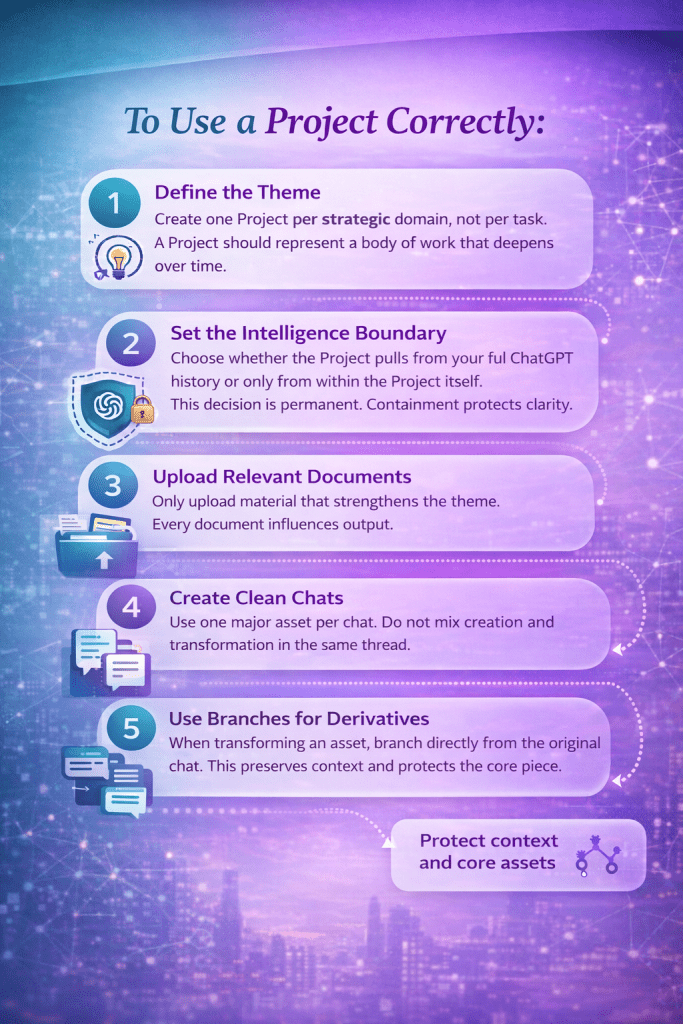
To use a Project correctly:
1. Define the Theme: Create one Project per strategic domain, not per task. A Project should represent a body of work that deepens over time.
2. Set the Intelligence Boundary: Choose whether the Project pulls from your full ChatGPT history or only from within the Project itself. This decision is permanent. Containment protects clarity.
3. Upload Relevant Documents: Only upload material that strengthens the theme. Every document influences output.
4. Create Clean Chats: Use one major asset per chat. Do not mix creation and transformation in the same thread.
5. Use Branches for Derivatives: When transforming an asset, branch directly from the original chat. This preserves context and protects the core piece.
This structure establishes governance before output.
This is not a productivity shortcut. It is a governed system designed for long-term authority.
Why Using ChatGPT Projects with EmpowerAi Agents Matters
Most people use AI as a conversation.
EmpowerAi™ installs architecture.
The hierarchy is clear:
Method → Project → Core Asset → Branch → Outputs
-
The Method governs the thinking.
-
The Project holds the strategic theme.
-
The core asset holds authority.
-
The branch handles transformation.
-
The agent performs a defined role.
This prevents drift, reduces duplication and builds compounding intellectual property.
Step 1: Create the Project Around a Strategic Theme
Your Project represents a domain of work, not a task.
Examples include:
-
Authority Blog Ecosystem
-
Offer Development
-
Programme Design
-
Client Research
Everything inside the Project must serve that theme. The Project becomes your contained thinking environment where depth develops and consistency strengthens.
Step 2: Choose the Intelligence Boundary Intentionally
When creating the Project, decide whether it will reference:
-
Your full ChatGPT history
-
Or Project-only containment
Full access prioritises convenience.
Project-only containment prioritises control.
For authority building and proprietary thinking, containment strengthens positioning and protects clarity.
Step 3: Create the Core Authority Asset in a Dedicated Chat
Open a new chat inside the Project specifically for your long-form article.
Bring in JERRY 📝 WriteWise1500.
Before giving instructions, ask:
“Jerry, what were you designed to do?”
This confirms role clarity before delegation.
Jerry will outline formatting expectations and then ask:
-
What is the exact target keyword?
-
Who is the primary audience?
-
What is the core angle?
Answer clearly and precisely.
This entire conversation becomes your core authority thread.
Do not repurpose inside this chat. This thread protects the integrity of your original thinking.
Step 4: Create a Branch Directly From the Article Thread
When the article is complete, do not continue in the same conversation.
Create a branch directly from the article thread.
The branch retains the full creation history while leaving the original untouched.
Name it clearly, for example:
“Social Media – Blog 01”
Bring in BEV 💬 SocialPro.
Ask:
“BEV, what were you designed to do?”
BEV will confirm that it transforms blog content into platform-optimised social media posts.
Now decide how you want to use the agent:
-
LinkedIn authority posts
-
Educational threads
-
Instagram captions
-
Engagement summaries
Then provide clear direction:
“Using the article in this thread, generate five LinkedIn posts for consultants.”
Original thread = Core authority asset
Branch = Controlled transformation layer
Alternative Option
You can bring a new agent directly into the original article thread.
However, this blends creation and transformation in the same space.
For structured authority building, branching preserves clarity and protects the integrity of the original asset.
Structure first. Flexibility second.
Step 5: Select the Best-Fit Agent for the Outcome
The Project remains stable.
You select the agent based on the outcome required.
For long-form authority:
JERRY 📝 WriteWise1500
For social media transformation:
BEV 💬 SocialPro
For search optimisation:
ISABELLA 💻 SEOGrowthNav
For extracting strategic insight:
STAR ⭐ ProInsightExtractor
For video scripts:
TAYLOR 🎞 VidScriptMaestro
For newsletters:
LUCY 📩 BiteNews
Ask each agent what it was designed to do. Then decide whether it aligns with your objective.
This is governed delegation, not random prompting.
Step 6: Maintain and Evolve the Project
A Project is a living strategic environment.
Regularly:
-
Remove outdated documents
-
Refine instructions
-
Update positioning
Without governance, authority erodes.
With structure, authority compounds.
Examples of Structured Chats Inside One Project
Inside “Authority Blog Ecosystem” you may have:
-
A long-form article chat with JERRY 📝 WriteWise1500
-
A branch titled “Social Media – Blog 01” using BEV 💬 SocialPro
-
A branch titled “Newsletter – Blog 01” using LUCY 📩 BiteNews
Each conversation has a defined role.
Each agent operates by design.
The Project holds the theme.
This is architecture in action.
Summary
Using ChatGPT Projects with EmpowerAi Agents is about governance, hierarchy and the protection of authority.
When you:
-
Define one Project per strategic theme
-
Set intelligence boundaries intentionally
-
Create core assets in protected threads
-
Branch for derivatives
-
Ask agents what they were designed to do
-
Select the best-fit agent deliberately
You move from scattered prompting to structured authority building.
EmpowerAi™ installs the architecture that governs this process.
Three Key Insights
1. A Project is an intelligence boundary, not a folder.
A folder stores information. An intelligence boundary governs it.
When you treat a Project as storage, you organise content. When you treat it as an intelligence boundary, you shape thinking. A Project determines what the system can access, what influences outputs and what remains outside the container.
Boundaries create discipline. Discipline protects clarity. Clarity sustains authority.
Without defined boundaries, ideas blend together, conversations overlap and strategic themes drift. A properly defined Project prevents that erosion. It creates a contained environment where thinking deepens instead of fragments.
A Project is not where content lives. It is where structured authority develops.
2. Branching protects authority assets while preserving context.
Branching is a structural safeguard.
When you branch from a core asset, you preserve the full creation history while separating transformation work from the source. The original thread remains intact. The reasoning, sequencing and strategic intent stay visible.
If you repeatedly repurpose within the same thread, instructions accumulate and clarity fades. Branching prevents this subtle erosion.
Authority assets remain stable reference points. Branches are where adaptation and amplification occur.
3. Deliberate agent selection strengthens structural integrity.
Agents are role-defined operators inside a governed system.
When you deliberately select an agent based on outcome, long-form authority, social transformation, SEO refinement or insight extraction, you reinforce structural clarity. Each agent operates within its design. Each task has a boundary.
When agents are introduced casually, roles blur and outputs lose precision. Structure weakens.
Governed delegation builds integrity. Reactive prompting fragments it.
Frequently Asked Questions
1. Why branch instead of starting a new chat?
Branching preserves the full creation history of your core asset while protecting it from dilution.
When you branch from an article thread, you keep every decision, refinement and structural choice intact in the original conversation while creating a separate space for transformation work.
Starting a completely new chat removes visible continuity. Continuing in the same thread layers instructions on top of the original asset. Branching protects both context and clarity.
2. Why ask an agent what it was designed to do?
Because role clarity strengthens output quality.
When you ask an agent what it was designed to do, you reinforce that it has a defined purpose inside the system. This prevents casual delegation and improves alignment between objective and output.
Deliberate use produces cleaner, stronger results.
3. Should every content format have its own Project?
No.
A Project should represent a strategic theme, not a format.
For example, “Authority Blog Ecosystem” can contain your long-form article, its social derivatives, newsletter versions and video scripts, all within the same governed container.
What changes is not the Project. What changes is the execution layer.
Use one Project per strategic domain. Use clean chats for core assets. Use branches for transformation.
This preserves hierarchy while allowing expansion.
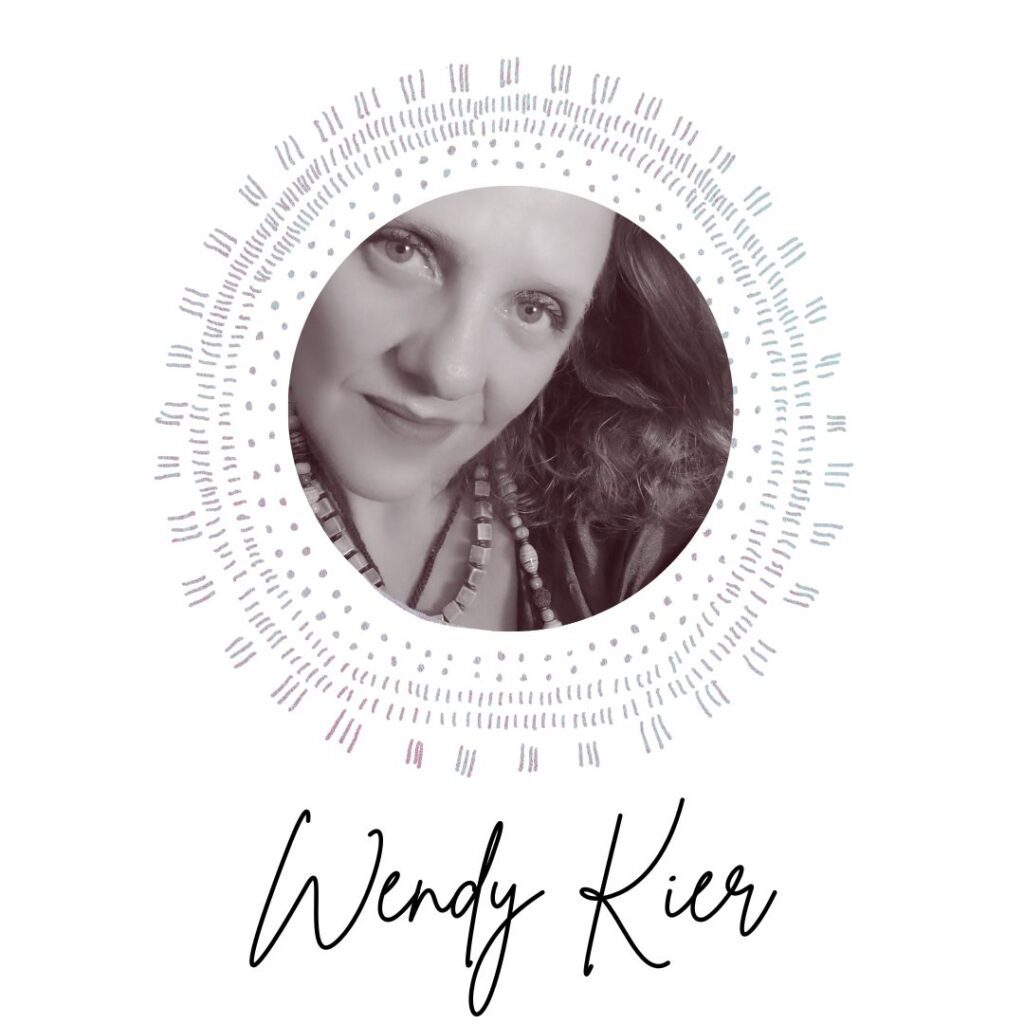
The Founder Wendy Kier
EmpowerAi™ was founded by Wendy Kier, an ethics-first artificial intelligence strategist working at the intersection of authorship, governance, and structured business architecture.
She understands the weight carried by experts whose knowledge cannot scale beyond their personal time and energy.
Her work is grounded in the belief that expertise should be translated into intelligent systems without compromising ownership, voice, or long-term authority.
EmpowerAi™ reflects this position. It is a methodology shaped by lived experience, strategic discipline, and a commitment to building artificial intelligence infrastructure that protects rather than extracts.
The methodology stands independently, but it is led by a founder who understands both the responsibility and the risk involved in architecting expertise for the age of intelligent systems.