
The Commercial Value of an AI Book Companion™ Agent (Beyond Book Sales)
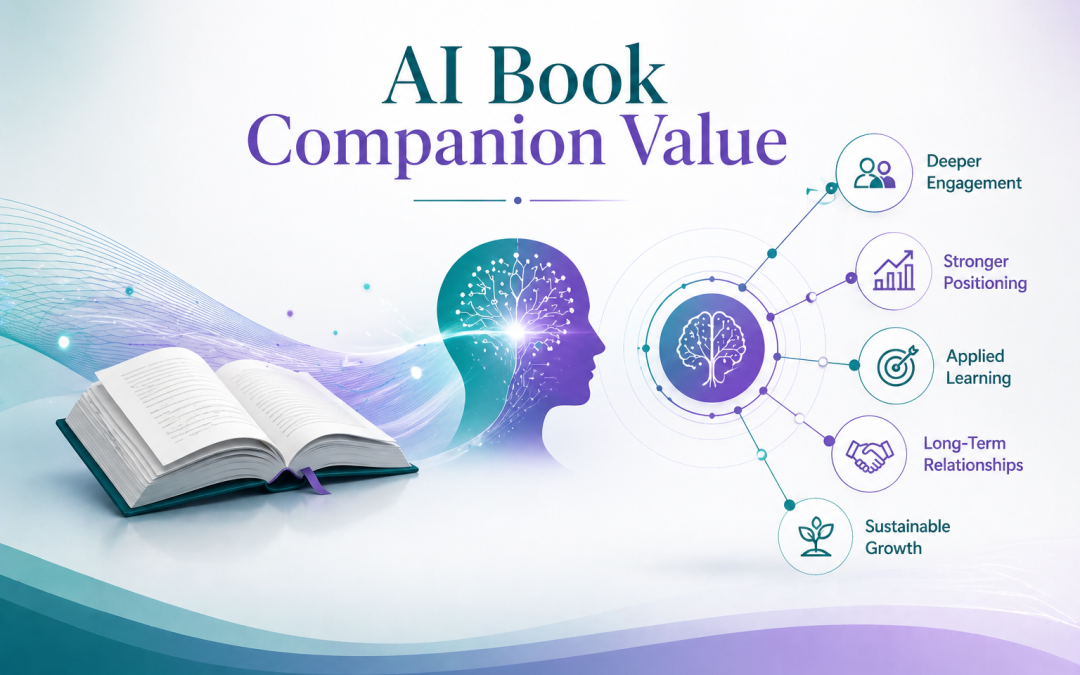
The commercial value of an AI Book Companion™ Agent sits beyond book sales. It comes from how your ideas are used over time, creating deeper engagement, stronger positioning, and ongoing pathways into your wider work.
When People Think About the Value of a Book
When people think about the value of a book, they tend to look at it through a fairly narrow lens, and that’s largely because the model has stayed the same for a long time.
They think about sales, visibility, and perhaps credibility. A book can open doors, position you differently, and create opportunities that wouldn’t have existed otherwise. All of that is valid, and it’s the reason many people write in the first place.
At the same time, it’s still quite a front-loaded model.
Most of the value is expected to happen around the launch, or in the period just after. There’s a burst of attention, some momentum, and then, gradually, things settle. The book remains, but the level of interaction with it tends to reduce quite quickly.
So when something like an AI Book Companion™ Agent is introduced, the first question people often ask is whether it will help sell more books.
It can, in some cases.
But that question keeps the thinking tied to the same model, where the book is still treated as a single event rather than something that continues to work over time.
If you step back and look more closely at what an AI Book Companion™ Agent actually is, the shift becomes easier to see: What Is an AI Book Companion™?.
The more useful question becomes what happens after someone has read the book, and how long the ideas remain active in their world.
Where People Start
A book is usually treated as an endpoint.
You write it, publish it, promote it, and then it sits there as a finished piece of work. Even when it does well, the pattern is broadly the same. There is a period of attention, followed by a gradual decline in engagement.
People read it once. Some take notes, a few return to it, but most move on, even if they found it valuable at the time.
The content itself doesn’t lose its relevance.
What drops off is the interaction with it.
There isn’t a natural mechanism that brings people back into the thinking in a structured way, so the depth of the work is often only partially realised.
This is explored in more detail here: Why a Book Is No Longer the End Product.
And it’s that gap, between the value of the ideas and how often they are actually used, that this begins to address.
What Changes With a Companion
An AI Book Companion™ Agent changes how the book is used over time, and it does so in a way that is quite subtle at first.
Instead of the book being something that is read and then set aside, it becomes something that can be returned to in a more active way. The reader is no longer simply revisiting the same content, they are engaging with it in context.
They might come back with a different situation, a new challenge, or a deeper understanding than they had the first time.
That allows them to revisit ideas from a different angle, apply concepts in a way that is specific to where they are now, and work through things they didn’t fully grasp or implement earlier.
So the shift is not just in how often the work is used, but in how deeply it is used.
The reader moves from consuming the material to working with it.
You can see how this plays out in practice here: How Readers Use an AI Book Companion™.
And that creates a different kind of relationship with the content, one that is ongoing rather than tied to a single reading.
Where the Value Actually Builds
The commercial value doesn’t sit in the Companion as a standalone feature.
It sits in what that continued interaction enables over time.
One of the first places this shows up is in the depth of engagement. Readers spend longer with the ideas, and more importantly, they apply them. That changes the level of value they experience, because it moves beyond understanding into use.
Alongside that, there is a shift in positioning. When your work is something people can interact with, rather than something they read once, it changes how you are perceived. You are no longer simply the author of a book, but the source of a way of thinking that people can return to and rely on.
This also has an effect on how your voice holds over time, particularly when AI is involved: The Difference Between Using AI and Letting AI Dilute Your Voice.
The third area is in how naturally people move towards the next step. Because the Companion sits alongside the work, it can guide readers towards further content, programmes, or services in a way that feels consistent rather than forced.
None of this relies on pushing anything.
It comes from how the system is structured and how the thinking is held.
Where This Fits in a Wider Ecosystem
For most authors, the book is only one part of a larger body of work.
There may be programmes, services, speaking, or ongoing content. Each of these exists, but they are not always connected in a way that feels seamless.
The Companion can sit across all of these.
It can support someone before they engage with you, by helping them understand your thinking. It can reinforce ideas while they are working with you, and it can continue to support them afterwards.
That continuity is where the value begins to build, because the work no longer exists in isolated pieces.
This becomes clearer when you look at how a book can function as a structured asset rather than a one-off output: How a Book Becomes a Living AI Asset.
It’s not about creating something separate, but about connecting what already exists.
Why This Is Not About Monetising the Tool
It is easy to look at this and think in terms of selling access to the Companion itself.
That is one option, and in some cases it may make sense.
But it tends to keep the focus on the tool rather than on the thinking behind it.
A more useful way to look at it is to see the Companion as part of a wider system rather than a standalone product.
This is where the shift from tool to asset becomes important: Why an AI Book Companion™ Is Not a Tool.
The book starts to function as an entry point, a support layer, and a bridge between different parts of your work.
And that is where the return tends to come from, not from the tool itself, but from how it connects and extends what you already have.
What This Looks Like in Practice
In practice, the impact tends to show up in ways that are quite understated.
Readers move more naturally from the book into a programme because they already understand how you think. Clients arrive with more clarity, which changes the quality of the work you can do together. People stay engaged with your ideas for longer, returning to them as their situation evolves.
None of these changes are dramatic in isolation.
But taken together, they begin to shift how the work performs.
If you want to see how this plays out in a real example, this is a useful reference point: AI Book Companion™ Bernie Curd Case Study.
Why Structure Still Matters
All of this depends on the Companion being built properly.
If the structure behind it is loose, the experience becomes inconsistent. The responses begin to vary, the thinking becomes less clearly defined, and over time the connection to the original work weakens.
This is explored more fully here: Why Uploading Your Book to ChatGPT Without Structure Is a Mistake.
And also in how the build itself is approached: How to Build an AI Book Companion™ Agent Properly.
The commercial value is not something that can be added afterwards.
It is a result of how well the thinking has been structured from the beginning.
Where This Leaves Authors
For authors, this is less about adding something new and more about using what already exists in a different way.
The book remains the foundation.
What changes is how that foundation is used.
The Companion creates more interaction, more application, and more continuity, which gradually shifts how the work is experienced and how it performs commercially.
If you want to see how this works as a complete system rather than a single idea, you can explore it here: AI Book Companion™ Agent.
Over time, the difference is not just in visibility or reach, but in how deeply the work is used.
Key Points to Take Away
- The value of an AI Book Companion™ Agent sits beyond book sales, in how the work is used over time.
- It increases engagement, strengthens positioning, and creates clearer pathways into other offers.
- The commercial impact comes from the system around the book, not just the book itself.
Questions & Answers
Does this increase book sales?
It can, particularly because readers stay connected to the work for longer. The more consistent impact, though, tends to come from what happens after the book has been read.
Can the Companion be sold as a product?
Yes, although it is often more effective when it sits within a wider ecosystem rather than being treated as a standalone offer.
How does it affect client work?
Clients tend to arrive with a clearer understanding of your thinking, which changes the quality of engagement and allows the work to move more directly into application.
What determines the commercial success?
The structure. A well-built Companion holds your thinking consistently, and that is what allows the value to build over time.