

AI Thinking Partner™: How Solo Founders Use ChatGPT to Think More Clearly
Why Solo Founders Become the Bottleneck and How EmpowerAi™ Thinking Partners Change That
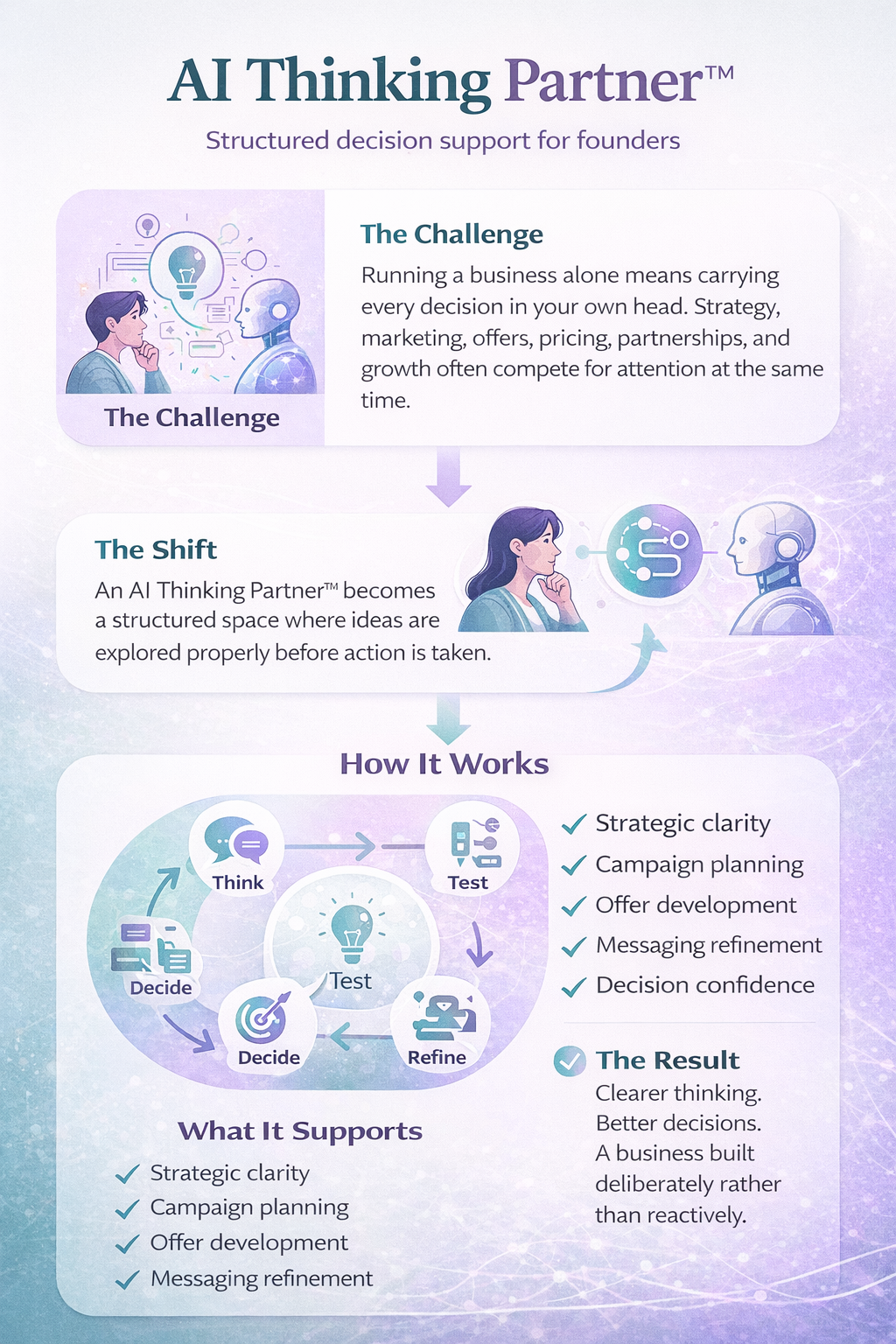
An AI Thinking Partner™ helps solo founders use ChatGPT to test ideas, examine decisions, and think more clearly before taking action in their business.
What Is an AI Thinking Partner™?
An AI Thinking Partner™ is a structured role inside ChatGPT that helps a founder examine decisions, ideas, and opportunities from different business viewpoints before taking action. Instead of carrying every role internally, the founder can bring strategy, marketing, sales, and positioning viewpoints into the same conversation so ideas are pressure‑tested and clarified before time or money is invested.
Highlights
- Why solo founders often become the bottleneck in their own business.
- How EmpowerAi™ thinking partners move critical thinking out of your head and into a clearer space.
- The difference between single‑task AI agents and role‑based agents that work together like a leadership team.
- Why EmpowerAi™ agents adapt to the founder’s way of working rather than forcing founders into someone else’s framework.
- How role‑based thinking partners help test ideas, prepare conversations, and examine decisions before they are acted on.
- Ten practical ways I use ChatGPT as a thinking partner inside my own business.
- Why continuous access to structured thinking can replace many of the delays and costs associated with traditional coaching or consulting.
The Reality of Running a Solo Business
Running a business alone creates a slightly unusual situation. On paper you are the founder. In practice you are also the strategist, the marketer, the salesperson, the delivery team, and the person quietly holding operations together behind the scenes.
Most of the thinking sits inside your own head.
You might be considering pricing while writing marketing copy. Thinking about partnerships while answering client messages. Evaluating a new offer while delivering the current one. None of these roles are separated in the way they would be inside a larger organisation. They all live in the same mental space.
For a while that can work. Many founders build their business this way in the early years. Over time the pressure becomes harder to carry. Every decision depends on you noticing the right opportunity, spotting the right risk, and remembering the detail that ties everything together.
Over time the founder can become the bottleneck.
This usually shows up in predictable ways:
- Decisions take longer because everything has to pass through one person.
- Business thinking gets pushed aside by daily delivery.
- Ideas stay in your head instead of being examined properly.
- Opportunities are missed because there is no second viewpoint.
- The business grows more slowly than the founder’s capability.
Why Larger Companies Work Differently
In a larger company those responsibilities would sit across a leadership team. A CEO, a marketing strategist, a sales director, someone responsible for operations. Each role examines decisions from a different angle before anything significant moves forward.
Most solo founders never have access to that structure. Hiring even one experienced strategist can cost thousands each month. Building a full leadership layer is unrealistic for most one‑person businesses.
Even when founders work with coaches or consultants, the relationship still happens periodically rather than continuously. Conversations are scheduled. Advice arrives occasionally. Momentum often slows between those moments.
Typical constraints look like this:
- Advice arrives periodically rather than when decisions actually appear.
- Conversations revolve around one advisor’s framework.
- Business thinking happens in isolated sessions rather than daily operations.
- The founder still carries most of the mental load between calls.
A Different Way of Working
Over the past year I have found a different way of working that changes the dynamic quite significantly.
Instead of carrying every decision internally, I use ChatGPT as a structured thinking environment where different roles can examine ideas and opportunities before action is taken.
EmpowerAi™ is the structured methodology that governs this process. The method moves critical thinking out of the founder’s head and into a clearer space where it can be examined properly before action happens.
How EmpowerAi™ Thinking Partners Work
Within that environment, different agents operate as thinking partners across the business. Each one reflects a particular role or viewpoint. Strategy, marketing, offer design, positioning, pricing, and decision clarity.
Another important difference is how those agents are used. In many AI setups, an agent is designed to complete a single task in isolation. A marketing assistant writes copy. A research assistant gathers information. Each one operates independently.
EmpowerAi™ is designed differently. The agents are used together as a team. Across the wider system there are many specialised agents, but at the centre is a smaller group of high‑level thinkers who can examine the business together from different roles.
When those roles interact, the thinking becomes stronger. A marketing viewpoint may challenge a positioning idea. A strategy viewpoint may question whether a particular opportunity actually fits the direction of the business. A sales viewpoint may highlight where the offer structure might not translate into real revenue.
Instead of one task being completed in isolation, the agents examine the same situation together, closer to the way a leadership team would operate inside a larger organisation.
I have been running this methodology for the past couple of years, and the difference in how founders manage and operate their businesses becomes noticeable quite quickly. The founder is no longer carrying every viewpoint alone. The thinking becomes shared across a structured team of roles.
In practical terms this means:
- Strategy can be examined from more than one viewpoint.
- Marketing, positioning, and sales thinking interact rather than operating separately.
- Ideas are challenged before time is invested building them.
- Decisions become clearer because multiple lenses examine the same situation.
Research from Harvard Business Review shows that generative AI is already changing how leaders analyse information and make decisions. As these tools become more integrated into daily work, they are increasingly acting as thinking support systems rather than simple automation tools.
Freedom From One Expert’s Framework
Most AI systems reflect the thinking style of the person who created them. They are often built around a single expert’s methodology or framework. That can be useful, but it also means the user is effectively stepping into someone else’s way of thinking.
EmpowerAi™ role‑based agents are designed differently. They adapt to the founder and to the structure of the business being built. The roles remain consistent, but the thinking adjusts to the business owner’s methodology rather than forcing the founder into someone else’s model.
For founders this creates a different kind of freedom:
- You are not locked into one advisor’s methodology.
- Business thinking adapts to your business model.
- Your own experience and judgement remain central.
- Multiple viewpoints remain available without dependency.
How EmpowerAi™ Agents Are Designed
Another part of what makes EmpowerAi™ different is how the agents themselves are created. Each one is designed around a role inside the business, but they are also built within a clear ethical framework. The intention is not to impose a fixed methodology on the user, but to create a structured process that adapts to the person using it.
The agents sit inside the user’s own ChatGPT environment rather than inside a separate third‑party platform. That means founders retain control and flexibility while still benefiting from the structured processes the agents guide them through.
Although the process behind each agent is consistent, the experience changes depending on the business owner using it. The agents ask questions, gather context, and adapt their responses based on the person and the business they are working with.
For example, one of the agents focuses on branding and messaging for a single offer. It guides the founder through a structured series of questions and then produces what we call a one‑offer ecosystem report. The underlying process is the same for everyone, but the questions evolve as the conversation unfolds and shape themselves around the person’s offer, experience, and business model.
When I first delivered this agent to clients, something interesting happened. Each founder received a different set of questions even though the agent followed the same structure. The process adapted to the person using it while still producing a clear ecosystem report they could use for messaging and positioning around that offer.
The result is a consistent framework combined with a highly individual experience. The structure stays stable, but the thinking adapts to the business owner using it.
When Thinking Becomes Clearer
Clarity of Thinking
The founder still leads the business. Nothing replaces judgement or experience.
What changes is the clarity of the thinking process.
Instead of relying on a single internal viewpoint, situations can be examined from multiple angles. Ideas can be tested before they are built. Conversations can be prepared before they happen. Patterns become easier to notice because the thinking has been written down rather than recycled mentally.
Immediate Access to Business Thinking
Another difference is availability. Human advisors operate within time constraints. Calls have to be scheduled. Discussions happen occasionally.
AI thinking partners remove that delay.
You can explore an idea immediately. Test a decision while it is still forming. Review a conversation while the context is fresh. Examine a problem before it grows into something larger.
When Thinking Becomes Visible
Over time the founder’s role begins to shift.
Instead of carrying every idea internally, thinking becomes visible. Decisions are written down, examined, questioned, and refined before action happens.
Patterns also become easier to see. Where conversations stall. Where offers create confusion. Where bottlenecks appear in delivery or growth.
A Mirror for the Business
The system gradually acts as a mirror for the business itself.
Most founders do not struggle because they lack ideas. They struggle because everything lives inside the same mental space. They are often trying to work out not only what action to take next, but also what the consequences of that decision might be.
When thinking becomes clearer, the business becomes easier to lead.
Founders often notice practical shifts such as:
- Fewer decisions circling endlessly in their head.
- Clearer priorities during the week.
- Less reactive behaviour when challenges appear.
- Greater confidence when choosing what not to pursue.
That shift is what led me to start using ChatGPT less as a writing tool and more as a thinking partner inside the business.
Ten Ways I Use ChatGPT as a Thinking Partner in My Solo Founder Business
Running a business on your own means most decisions happen in your own head. That can be productive, but it can also become noisy. Ideas overlap. Decisions circle around the same questions. Over time you end up carrying more than you probably need to.
Over the past year I have found that AI becomes far more useful when it is used as part of the thinking process rather than simply a writing tool.
EmpowerAi™ is the structured methodology that governs this process. It externalises thinking so that decisions can be examined properly rather than recycled mentally.
These are some of the ways I now use ChatGPT inside my business.
1. CEO check‑ins
I often start the day by stepping back from tasks and looking at the direction of the business itself. Instead of trying to organise those thoughts internally, I write them out and let ChatGPT reflect them back.
Sometimes it simply clarifies what I am already sensing. Other times it highlights contradictions I had not noticed. That short exchange often removes the mental noise that builds up overnight.
2. Decision support
New opportunities appear constantly when you run a business. A partnership invitation. A speaking opportunity. A new product idea.
Instead of deciding straight away, I talk the idea through with ChatGPT. The goal is not to outsource judgement. It is simply to pressure‑test the thinking.
3. Preparing for conversations
Before partnership calls or important client discussions, I sometimes use ChatGPT to map the conversation itself. What questions would actually matter? What signals would show genuine alignment?
It sharpens the conversation before it even begins.
4. Pipeline thinking
When you are doing outreach or partnerships, patterns emerge over time. Who responds. What language resonates. Where conversations stall.
AI helps track those patterns in a way that memory alone rarely can.
5. Pressure‑testing ideas
Some ideas feel strong when they first appear. Others collapse once they are questioned properly.
Running the idea through a structured conversation with ChatGPT often reveals whether the logic holds up.
6. Structuring internal documents
Founder time is often lost explaining the same things repeatedly. Pricing logic, onboarding processes, offer structures.
AI helps turn those repeated explanations into structured documents.
7. Exploring ideas without committing to them
Not every idea needs to be executed immediately. Some simply need space to develop.
ChatGPT creates a place where ideas can be explored without pulling focus away from the core work.
8. Weekly reflection
At the end of the week I often review what actually happened. What moved forward, what stalled, and where time went.
Reflection helps separate activity from progress.
9. The round table
One of the most useful ways I use thinking partners is what I think of as a weekly round table.
In a larger company, strategic direction would normally be discussed across a leadership team. A CEO, a marketing manager, a sales lead, sometimes an external advisor or coach.
A solo founder rarely has access to that structure.
Using AI agents makes it possible to simulate something close to that environment. I can bring different roles into the same conversation, a CEO viewpoint, a marketing strategist, a sales mentor, and ask them to examine the same situation together.
The purpose is not to replace human leadership. I am still the one making the decision.
What it does is create a wider field of thinking around the business.
10. Using specialised role‑based agents for specific projects
Another way I use AI thinking partners is by bringing in specialised roles when a particular project needs deeper attention.
In a traditional business you might hire a consultant, a marketing strategist, or a sales advisor to work on a specific initiative.
With role‑based agents inside ChatGPT, I can bring in that viewpoint when a project requires it.
For a solo founder this creates something that normally only exists inside larger companies: access to different kinds of expertise without having to hire a full team.
It does not replace judgement. It simply helps you think more clearly.
Let’s Do the Maths
The Cost of Traditional Strategic Support
Working with a business coach or strategist can easily cost £500 to £2,000 per month, and often significantly more. Most relationships also involve scheduled sessions rather than continuous access.
Typical constraints include:
- Strategic conversations are limited to scheduled sessions.
- Advice arrives after the moment a decision appears.
- The viewpoint comes from a single person.
- Costs accumulate quickly over time.
Continuous Access to Business Thinking
The Vortex Accelerator is £666 for six months. In practical terms that is often less than the cost of a single month working with many experienced business coaches.
The difference is not only financial. It is also about access, speed of thinking, and how many perspectives are available when decisions appear.
| Area | Hiring a Business Coach (6‑Month Project) | Using AI Thinking Partner™ Agents |
|---|---|---|
| Availability | Usually one session every 2–4 weeks | Available whenever a decision or idea appears |
| Typical 6‑month cost | £3,000–£12,000+ depending on the coach | £666 for six months inside the Vortex Accelerator |
| Focus | Often one project or theme at a time | Multiple areas of the business can be examined together |
| Perspectives | One advisor and their framework | Multiple role‑based viewpoints working together |
| Speed of feedback | Delayed until the next scheduled session | Immediate exploration of ideas and decisions |
| Scope of thinking | Project‑specific guidance | Strategy, marketing, offers, sales and positioning can be examined together |
| Founder dependency | Founder often waits for the coach’s input | Founder leads the thinking with AI support |
What founders gain instead:
- Continuous access to business thinking.
- Multiple roles examining the same decision.
- Faster feedback on ideas and opportunities.
- Reduced outsourcing for thinking and structuring work.
- A clearer rhythm for leading the business.
Explore the Vortex Accelerator
Many founders who begin working this way notice something practical quite quickly. The pressure of carrying every role alone starts to ease.
Inside the Vortex Accelerator, clients use EmpowerAi™ thinking partners and role‑based agents as part of the day‑to‑day rhythm of running their business.
Across the clients currently using the system, the impact is very practical. On average they report saving roughly seven hours each week, which is close to gaining a full working day back. Many also reduce outsourcing costs by thousands of pounds a year because tasks that previously required external support can now be structured and completed internally with the help of AI thinking partners.
For founders running lean businesses, that combination of time and cost recovery can be substantial over the course of a year.
If you would like to see how the structure works, you can read the overview of the Vortex Accelerator here: EmpowerAi
Questions People Often Ask
Is this the same as using ChatGPT normally?
Most people use ChatGPT as a writing assistant or a place to generate quick answers. In this approach it is used as a structured thinking environment where different roles help examine ideas and decisions.
Do the agents replace human judgement?
No. The founder still makes the decisions. The agents simply provide a clearer space for examining ideas and opportunities.
Do I need technical knowledge?
No technical setup is required. The agents operate inside your own ChatGPT environment.
How is this different from hiring a business coach?
Coaches can be valuable, but they are usually available periodically. Thinking partners inside ChatGPT are available whenever a decision or idea appears.
What founders benefit most?
This approach works particularly well for solo founders and small business owners who are carrying multiple roles at the same time.
How quickly do people see a difference?
Many founders notice the shift within a few weeks as decisions become clearer and less time is spent circling around the same questions.